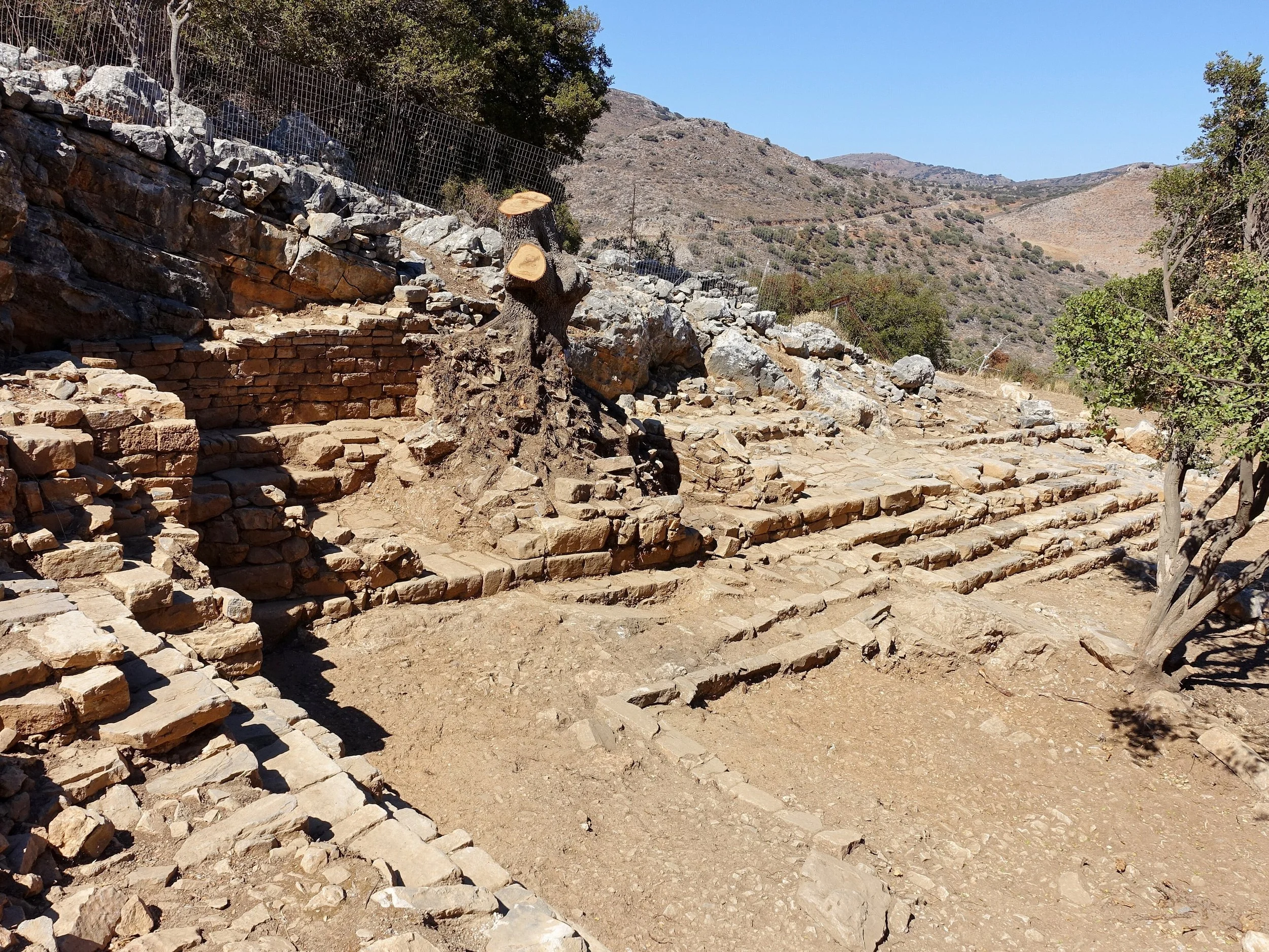
Ancient Dreros, Crete
Discover an Ancient Greek City Near Neapoli
Ancient Dreros, Crete – Discover an Ancient Greek City Near Neapoli
Located on two hills of Mount Kadistos, approximately 3 kilometres northeast of Neapoli in eastern Crete, Ancient Dreros is one of the island's most interesting archaeological sites. Overlooking the surrounding valleys and countryside, this ancient city offers a fascinating glimpse into the development of Greek civilisation in Crete, particularly during the Geometric, Archaic and Hellenistic periods.
Unlike the famous Minoan palaces of Knossos, Malia and Zakros, Dreros belongs to a later chapter of Cretan history. It is especially important for its early temple dedicated to Apollo, its ancient public buildings and some of the oldest known examples of written Greek law.
The History of Ancient Dreros
Dreros developed as an important settlement during the Geometric period, with evidence of its growth as a city-state becoming particularly clear during the 8th and 7th centuries BC.
Its position was strategically chosen. Built across two neighbouring hills with a natural saddle between them, the city could control routes connecting central and eastern Crete. The surrounding fertile valleys supported agriculture, while the nearby mountains provided opportunities for livestock farming.
During the Archaic period, Dreros developed into an organised community with public institutions, religious sanctuaries and its own laws. Inscriptions discovered at the site reveal a society with established political structures and rules governing public life.
The city remained significant during the Classical and Hellenistic periods. In the late 3rd century BC, however, Crete experienced political conflicts and rivalries between its city-states. Dreros became involved in these struggles and was eventually conquered by the neighbouring city of Lyttos. Its importance subsequently declined, although activity in the wider area continued in later periods.
The Temple of Apollo Delphinios
One of the most important monuments at Dreros is the Temple of Apollo Delphinios, dedicated to Apollo in his Delphinios aspect.
Dating to the Geometric period, the sanctuary is among the earliest known Greek temples in Crete. Its importance extends beyond its architecture, as it provides valuable evidence of the religious practices and artistic traditions of early Greek communities on the island.
The temple is particularly famous for three small bronze statuettes representing Apollo, Artemis and Leto, the divine family of Apollo. These remarkable figures were discovered during excavations in 1935 and are among the most celebrated finds associated with Dreros. They are now preserved in the Archaeological Museum of Heraklion.
The sanctuary demonstrates the importance of religious worship in the public and social life of the ancient city.
The Agora and the Ancient Cistern
At the centre of Dreros was the agora, the main public space where citizens gathered and important civic activities took place.
The area included architectural remains associated with public life, including stepped structures and a large ancient cistern. The cistern is particularly impressive because of its scale and the engineering required to collect and store water for the city's inhabitants.
The water system highlights the practical challenges faced by communities living on elevated terrain and their ability to organise shared infrastructure.
The agora is also associated with important archaeological inscriptions. Among the most significant are legal texts that provide evidence of the city's political organisation during the Archaic period.
Ancient Laws and the Oath of the Young Citizens
Dreros holds an exceptional place in the history of ancient Greek law.
An important group of inscriptions discovered at the site includes some of the earliest surviving examples of Greek legislation. One inscription, dating to approximately 650–600 BC, records a constitutional rule limiting how frequently a citizen could hold the office of kosmos, one of the principal magistracies of the Cretan city-states.
The restriction prevented the same individual from holding the office again before a period of ten years had passed. It offers valuable evidence of early attempts to regulate political power and public responsibilities.
Another famous inscription records an oath taken by 180 young citizens of Dreros, known as the ephebes, during the late 3rd century BC. The text reflects their commitment to their city and its allies, providing a rare insight into civic identity and the responsibilities of young members of the community.
Together, these discoveries make Dreros particularly important for understanding the political and social organisation of ancient Crete.
The Archaeological Excavations
The remains of Dreros attracted attention during the 19th century, and systematic archaeological excavations began in 1917 under the archaeologist Stephanos Xanthoudidis.
Further investigations were carried out by French archaeologists, including Pierre Demargne and Henri van Effenterre, while Spyridon Marinatos investigated the temple and its remarkable bronze statuettes during the 1930s.
More recent research has been conducted through collaboration between the Ephorate of Antiquities of Lasithi and the French School at Athens. Excavations have explored the agora, temples, residential buildings and other areas of the ancient settlement.
Research has also revealed substantial Hellenistic buildings, including a complex with a central room and adjoining storage rooms. Archaeological work continued in 2025, demonstrating that Dreros remains an active subject of historical investigation.
What You Can See at Ancient Dreros
The archaeological remains are spread across the two hills and the saddle connecting them. As you explore the area, you can discover:
The Temple of Apollo Delphinios: The remains of one of the earliest Greek sanctuaries in Crete.
The Ancient Agora: The central public area of the city, where civic and communal activities took place.
The Large Cistern: An impressive example of ancient water management and engineering.
Ancient Buildings: Remains of public and residential structures from different periods.
The Acropolis Areas: The elevated parts of the settlement, which reveal the city's strategic position and layout.
The site is not a fully reconstructed archaeological park. Much of its interest lies in understanding the original organisation of the city and the landscape in which it developed.
Visiting Ancient Dreros
Ancient Dreros is located approximately 3 kilometres northeast of Neapoli and around 30 minutes by car from Agios Nikolaos. The approach leads towards Mount Kadistos and the area of the Church of Saint Anthony.
The remains are spread across uneven terrain, so comfortable walking shoes and suitable sun protection are recommended. Visitors should also respect archaeological boundaries and avoid entering restricted areas.
Unlike major archaeological attractions in Crete, Dreros does not have the same level of visitor infrastructure. Public opening arrangements and access conditions should be confirmed with the local archaeological authorities before making a special trip. Do not assume that the site is accessible simply because it appears on a map.
Places to Explore Near Dreros
A visit to Ancient Dreros can be combined with several interesting destinations in the surrounding area:
Neapoli: A traditional town with a historic centre, churches and local character.
Ancient Lato: Another important ancient city-state, near Kritsa, with impressive archaeological remains and views over Mirabello Bay.
Fourni: A traditional settlement surrounded by countryside and historic religious monuments.
Kremasta Monastery: A historic monastery near Neapoli, known for its distinctive setting.
Agios Nikolaos: The coastal town of Mirabello, with Lake Voulismeni, its harbour, restaurants and waterfront.
Discover Another Chapter of Ancient Crete
Ancient Dreros offers a different perspective on Crete's rich archaeological heritage. Its early temple, public spaces, ancient laws and remarkable inscriptions reveal how organised communities developed on the island long after the Minoan palaces.
For visitors interested in ancient history, Dreros is a rewarding place to discover, particularly when exploring the wider archaeological landscape around Neapoli, Lato and Agios Nikolaos.