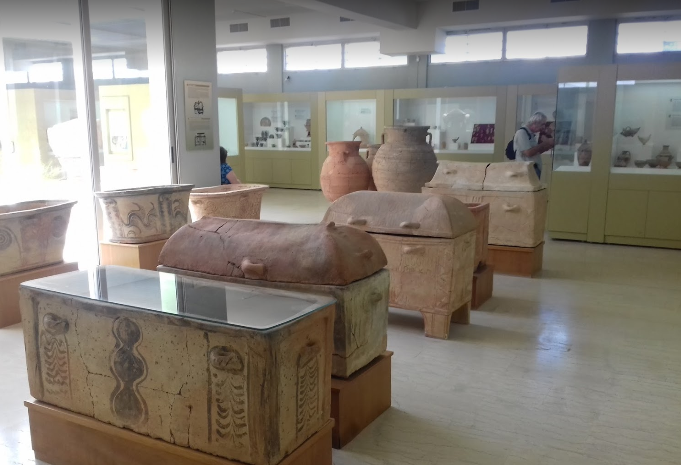
Archaeological Museum of Sitia, Crete
Discover the Treasures of Eastern Crete
Archaeological Museum of Sitia, Crete – Discover the Treasures of Eastern Crete
Located in the town of Sitia, on the eastern coast of Crete, the Archaeological Museum of Sitia houses an exceptional collection of discoveries from some of the island's most important ancient settlements. From Early Minoan pottery and remarkable gold and ivory objects to Hellenistic sculptures and Roman artefacts, the museum offers a fascinating journey through approximately 4,000 years of history.
Its collection covers the period from around 3500 BC to 500 AD, bringing together discoveries from archaeological sites across the wider Sitia region, including Palaikastro, Mochlos, Zakros, Itanos, Petras and ancient settlements along the eastern coast.
For visitors exploring eastern Crete, this museum is an excellent opportunity to understand the history and archaeology of a region that played an important role in the development of Minoan civilisation.
The History of the Museum
The Archaeological Museum of Sitia was officially inaugurated in 1984 by Melina Mercouri, who was serving as Greece's Minister of Culture at the time.
The building was designed around a small central courtyard, creating a natural arrangement for the exhibition spaces. Its collections were organised to present the archaeological history of the region through different chronological periods.
The museum brings together discoveries from excavations conducted across eastern Crete, many of which reveal the importance of the area during the Bronze Age and later historical periods.
Although relatively compact compared with the larger museums of Heraklion and Agios Nikolaos, its collection contains some exceptionally important archaeological objects.
The Kouros of Palaikastro – The Museum's Most Famous Treasure
The most celebrated exhibit is undoubtedly the Kouros of Palaikastro, an extraordinary Minoan statuette made from several different materials.
Discovered during excavations at the Minoan settlement of Palaikastro, the figure dates to the Late Minoan period, around 1500 BC.
Standing approximately 54 centimetres tall, it is composed of materials including hippopotamus ivory, serpentine stone, rock crystal, wood and gold.
The statuette represents a youthful male figure and is considered one of the finest examples of Minoan sculpture. Its exceptional craftsmanship and combination of materials demonstrate the artistic abilities and technical knowledge of Minoan artisans.
The discovery is particularly significant because very few comparable Minoan sculptures have survived in such a remarkable form.
Seeing the Kouros in person is one of the highlights of visiting the Archaeological Museum of Sitia.
The Minoan Collection – A Journey Through Eastern Crete
Several exhibition areas are dedicated to the prehistoric and Minoan periods, presenting discoveries from settlements and cemeteries across the region.
Among the most important collections are:
The Cemetery of Agia Fotia
The Early Minoan cemetery of Agia Fotia, near Sitia, dates approximately to 3000–2500 BC.
It is one of the largest prehistoric cemeteries discovered in Crete and contains important evidence of connections between Crete and the Cycladic islands.
The museum displays handmade pottery, stone objects and obsidian blades discovered in the graves. The distinctive pottery styles reveal cultural influences and exchanges across the southern Aegean during the Early Bronze Age.
The Minoan Settlement of Mochlos
The island of Mochlos was an important coastal settlement during the Early and Middle Minoan periods.
Its archaeological discoveries include beautifully crafted pottery, stone vessels and objects associated with everyday activities and religious practices.
One particularly interesting exhibit is a ceramic bull-shaped rhyton, a ritual vessel connected with Minoan ceremonial traditions.
Palaikastro and the Minoan Religious World
The archaeological site of Palaikastro was one of the most important Minoan settlements in eastern Crete.
The museum displays objects from its excavations, including ritual vessels, pottery and religious artefacts.
Among the exhibits are objects associated with Minoan sanctuaries, including sacred horns and vessels decorated with marine and natural motifs.
These discoveries provide valuable insight into Minoan religious practices and the artistic traditions of the eastern part of the island.
The Palace of Kato Zakros
The Minoan Palace of Zakros was an important administrative and commercial centre, with connections to the eastern Mediterranean.
The museum preserves a selection of objects discovered during excavations at the palace, including pottery, ritual vessels and other archaeological material.
These exhibits help illustrate the importance of maritime trade and the connections between Crete, Egypt and the wider eastern Mediterranean during the Bronze Age.
Linear A – The Mystery of Minoan Writing
Another particularly interesting part of the collection is dedicated to Linear A, the writing system used by the Minoans.
The museum displays clay tablets and other inscribed objects discovered at archaeological sites in eastern Crete.
Some of these tablets were preserved because they were accidentally baked during the fires that destroyed ancient buildings.
Linear A remains undeciphered, meaning that its language and full meaning are still not understood. The inscriptions provide important evidence of the administrative systems used by Minoan communities.
For visitors interested in ancient writing and the mysteries of Minoan civilisation, this collection is especially fascinating.
From Hellenistic Cities to Roman Crete
The museum also explores the later history of eastern Crete, with exhibits from Hellenistic and Greco-Roman settlements.
Among the represented archaeological sites are:
Xerokampos: Important Hellenistic discoveries, including pottery, figurines, coins and objects associated with domestic and religious life.
Ancient Itanos: Finds from this historic coastal city, which played an important role in maritime trade.
Petras: Objects from the archaeological settlement and its surrounding cemetery.
Koufonisi (Ancient Leuke): Discoveries from the Roman settlement on this small island south of Crete, including everyday objects associated with fishing and the production of purple dye.
Trypitos: Finds from the Hellenistic city near Sitia, providing evidence of urban life during the later ancient periods.
Together, these exhibits demonstrate that eastern Crete remained an important region long after the decline of the Minoan palaces.
What Visitors Say About the Museum
The Archaeological Museum of Sitia receives generally positive feedback from visitors.
On Tripadvisor, it has a rating of approximately 4.3 out of 5, with around 46 reviews at the time of writing.
Visitors particularly appreciate:
The impressive Kouros of Palaikastro, which many consider the highlight of the collection.
The variety of archaeological objects from different periods.
The well-organised exhibition and information presented in Greek and English.
The opportunity to discover archaeological finds from eastern Crete without travelling between several different sites.
The helpful and welcoming museum staff.
Some visitors mention that the museum is relatively small and that the exhibition spaces can feel warm during the summer. Others would appreciate more detailed explanations accompanying certain objects.
Overall, it is widely regarded as a worthwhile cultural visit, especially for anyone interested in Minoan history and archaeology.
Visiting the Archaeological Museum of Sitia
The museum is located on the National Road between Sitia and Piskokefalo, approximately one minute by car from the town centre.
According to the official Hellenic Heritage visitor information:
Opening hours: 08:30–15:30, Monday and Wednesday to Sunday.
Closed: Tuesdays.
Full admission: €5.
Reduced admission: €3.
Last admission: 20 minutes before closing.
The museum is open during both the summer and winter seasons under the published schedule. Opening arrangements and admission prices can change, so check the official information before your visit.
The museum provides parking, a ramp and accessible toilets.
Telephone: +30 28430 23917
Email: efalas@culture.gr
Places to Explore Near the Museum
Sitia and the surrounding region offer several fascinating archaeological, historical and natural attractions.
Ancient Itanos: Explore the remains of an ancient coastal city near Vai, with archaeological evidence of maritime trade and early Christian buildings.
Vai Palm Forest: Discover one of Crete's most distinctive natural landscapes, famous for its natural palm forest and beautiful beach.
Toplou Monastery: Visit an important historic monastery known for its architecture, religious heritage and impressive icons.
Palaikastro: Explore the archaeological remains of an important Minoan settlement, the place where the famous Kouros was discovered.
Minoan Palace of Zakros: Discover the easternmost of the major Minoan palaces, near the spectacular Zakros Gorge.
Ancient Praisos: Visit the remains of an important Eteocretan city, known for its ancient inscriptions and historical significance.
Discover the Archaeological Heritage of Eastern Crete
The Archaeological Museum of Sitia is an essential stop for anyone interested in the history of eastern Crete. Its collection brings together remarkable discoveries from Minoan settlements, ancient cities and coastal communities, revealing the cultural and commercial importance of the region over thousands of years.
From the extraordinary Kouros of Palaikastro to the mysterious Linear A inscriptions, the museum offers a memorable introduction to the archaeological treasures of this part of the island.
If you are travelling through Sitia, Zakros, Palaikastro or the eastern coastline, make time to explore this museum and discover another fascinating chapter of Crete's history.