Holy Monastery of Areti, Karydi – Crete
Holy Monastery of Areti, Karydi – Crete
The Holy Monastery of Areti, also known as the Monastery of the Holy Trinity, is one of the historic monasteries of the Mirabello region in eastern Crete. It is located near the village of Karydi, in the Lasithi countryside, approximately 25 km north of Agios Nikolaos.
Founded towards the end of the 16th century, the monastery became an important religious and economic centre during the Venetian period. Its fortified architectural character, traditional courtyards and collection of 17th-century icons make it a significant part of Crete's religious and cultural heritage.
History and Religious Significance
The monastery was founded around the end of the 16th century by Markos Papadopoulos, a local landowner who dedicated considerable property to its establishment and maintenance. According to historical accounts, his donation was sufficient to support a community of twelve monks.
During the 17th century, the monastery experienced a period of prosperity. Notarial documents from this time record numerous transactions with other monasteries and private individuals, demonstrating its economic importance and its connections with the surrounding region.
Its history was marked by periods of destruction and decline. During the Greek Revolution of 1821, the monastery was attacked and damaged by Ottoman forces, and its valuable library was destroyed. Despite these events, parts of the complex continued to be used and were renovated during the 19th century.
The monastery was re-established in 1955–1956, and extensive restoration work took place during the 1990s, helping preserve the historic buildings and return the complex to religious use.
Architecture and Monastery Complex
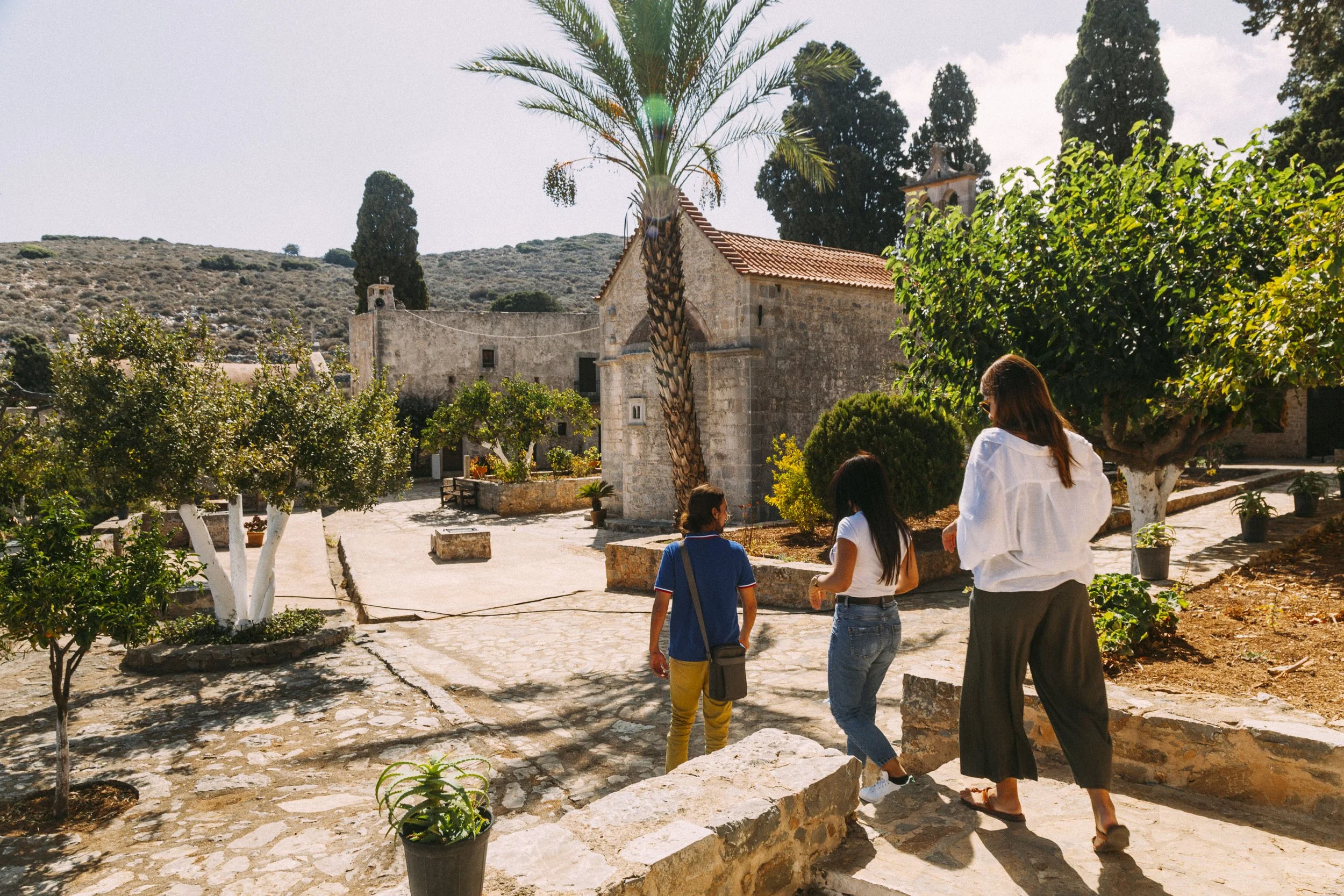
The Monastery of Areti is a notable example of a traditional Cretan monastic complex. Its buildings follow the natural slope of the ground and are arranged around two courtyards, creating a series of interconnected spaces.
The smaller southern courtyard contains the main entrance and was traditionally associated with the monastery's practical activities. Around it were workshops and auxiliary buildings, including an olive press, a wine press and stables. These facilities reflect the self-sufficient character of monastic life, when monasteries relied on agricultural production and local resources.
The larger central courtyard forms the heart of the complex. Here stands the main church, or Katholikon, dedicated to the Holy Trinity, together with the chapel of Saint Lazarus. The monks' cells and other principal rooms are arranged in two-storey buildings around this courtyard.
The combination of religious, residential and agricultural spaces gives the monastery the character of a small, organised settlement within its surrounding landscape.
The Katholikon and Historic Icons
The central church is dedicated to the Holy Trinity and was renovated in 1880–1881. It is one of the most important features of the monastery, both architecturally and artistically.
Inside the Katholikon are preserved significant icons belonging to the Cretan School of icon painting, dating from the 17th century. Among the most notable are representations of the Holy Trinity, the Lady of the Angels and Pentecost. These three works are attributed to the same anonymous painter and are particularly important examples of the artistic tradition that flourished in Crete during the period.
The nearby chapel of Saint Lazarus is another notable part of the complex. Its original purpose is not fully established, although it has been suggested that it may have had a funerary function.
What to See at the Monastery
Visitors interested in the history and architecture of the Holy Monastery of Areti should look out for:
The central courtyard: The main open space of the monastery, surrounded by its principal buildings.
The Katholikon of the Holy Trinity: The main church, renovated in the late 19th century.
The 17th-century icons: Important works of the Cretan School depicting the Holy Trinity, the Lady of the Angels and Pentecost.
The Chapel of Saint Lazarus: A smaller religious building near the main church.
The southern courtyard: The area associated with the monastery's former workshops and agricultural facilities.
Traditional monastery buildings: The cells, olive press, wine press and other spaces that illustrate the daily organisation of monastic life.
Visiting the Holy Monastery of Areti
The monastery is located near Karydi in the Mirabello region of Lasithi, approximately 25 km north of Agios Nikolaos. It can be reached by road and is included in routes connecting Elounda, Neapoli and Kritsa.
The monastery celebrates the Holy Trinity on Pentecost Sunday, one of the principal dates in its religious calendar. As it is a religious site, visitors should dress respectfully and maintain a quiet atmosphere. It is advisable to check access arrangements before visiting, as opening times may vary.