Nikos Kazantzakis Museum, Myrtia
Discover the Life and Work of Crete’s Great Writer
Nikos Kazantzakis Museum, Myrtia – Discover the Life and Work of Crete’s Great Writer
Located in the traditional village of Myrtia, in the Heraklion region of Crete, the Nikos Kazantzakis Museum is dedicated to the life, literary work and ideas of one of Greece’s most internationally recognised writers. Through manuscripts, personal belongings, photographs, letters and theatrical material, the museum offers visitors an insight into the man behind some of modern Greek literature’s most celebrated works.
Nikos Kazantzakis is best known internationally for Zorba the Greek, The Last Temptation of Christ and Freedom or Death (Captain Michalis). A visit to the museum provides an opportunity to discover not only his books but also his personality, travels, friendships and intellectual influences.
Who Was Nikos Kazantzakis?
Nikos Kazantzakis was born in Heraklion, Crete, in 1883 and became one of the most influential Greek writers and thinkers of the 20th century. His work explored subjects such as freedom, spirituality, human struggle, philosophy and the search for meaning.
He travelled extensively and lived in several countries, drawing inspiration from different cultures, historical events and philosophical traditions. His writing includes novels, poetry, travel books, plays, essays and philosophical works.
Among his best-known books are Zorba the Greek, The Last Temptation of Christ, Captain Michalis and The Odyssey: A Modern Sequel. His works have been translated into numerous languages, introducing readers around the world to Greek literature and his distinctive way of thinking.
Kazantzakis died in Freiburg, Germany, in 1957. His grave is located on the Martinengo Bastion of the Venetian walls in Heraklion.
The History of the Nikos Kazantzakis Museum
The museum was founded in 1983 by George Anemogiannis, an important Greek theatre set and costume designer. Its creation was closely connected to Myrtia, the ancestral village of the Kazantzakis family, and the desire to preserve the writer’s memory and make his work accessible to future generations.
The museum occupies a site associated with the Anemoyiannis family, which had family connections with Kazantzakis’ father, Captain Michalis. The location therefore has a meaningful connection to the writer’s family background and his relationship with the area.
Following an extensive renovation, the museum reopened with a modern exhibition concept in 2009. Today, it combines traditional archival material with contemporary presentation methods, multimedia displays and educational activities.
What Can You See at the Museum?
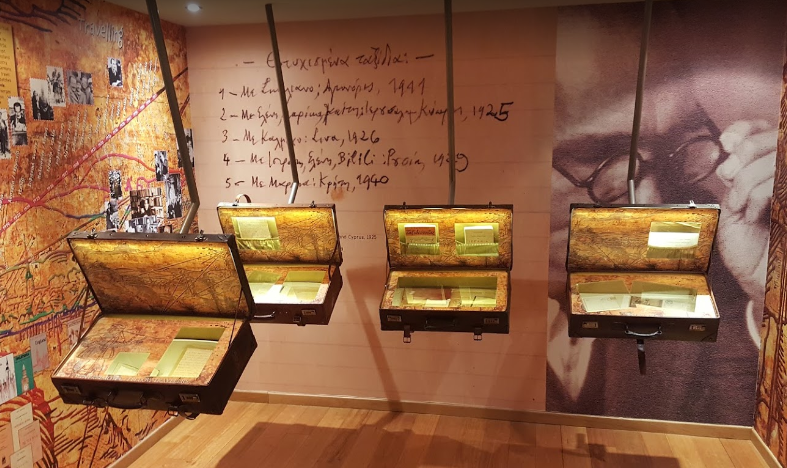
The permanent exhibition presents approximately 650 exhibits, arranged to explore different aspects of Kazantzakis’ life and creative work. Rather than presenting only a collection of books, the museum allows visitors to follow the experiences and ideas that shaped the writer.
Highlights include:
Personal belongings: Objects connected to Kazantzakis’ everyday life, offering a more personal view of the writer.
Letters and manuscripts: Original documents, correspondence, diaries and material related to the development of his literary works.
Books and publications: Editions of his writings, including material showing how his work reached readers in Greece and abroad.
Travels and photographs: Photographs, souvenirs and documents reflecting his journeys and encounters with different cultures.
Theatre and cinema: Models of stage sets and costumes, along with material relating to theatrical performances and adaptations of his works.
Audiovisual material: Multimedia presentations that help visitors understand his life, ideas and literary legacy.
The museum also preserves a substantial archive of documents and material connected to Kazantzakis and his work. Its collection and research activities extend beyond the objects displayed in the permanent exhibition.
A Museum for Literature, Culture and Education
The Nikos Kazantzakis Museum is more than a biographical exhibition. It is also an active cultural institution that organises educational programmes, events, workshops, conferences and other activities.
Its educational department offers activities for children, families, teenagers and adults, introducing visitors to Kazantzakis through literature, art and interactive learning.
The museum also provides digital experiences, including an online tour of its permanent exhibition. These resources make it possible to explore aspects of the collection even before arriving in Myrtia.
For anyone interested in Greek literature, modern history or the cultural identity of Crete, the museum offers a different perspective from the island’s better-known archaeological attractions.
Where Is the Nikos Kazantzakis Museum?
The museum is located in the central square of Myrtia, a traditional village in the Municipality of Archanes-Asterousia, approximately 15 kilometres south of Heraklion.
It is also a convenient cultural stop when exploring the wider Heraklion area, particularly in combination with the Palace of Knossos and the surrounding villages.
The museum can be reached by car from Heraklion by following the road towards Knossos and then continuing towards Skalani and Myrtia. Visitors should follow the local signs for the museum.
Public transport is possible, but services are limited. The museum's official website provides information about the KTEL connection from Heraklion towards Kastelli, including selected services that reach Myrtia directly. Check the current timetable before travelling.
Opening Hours and Tickets
According to the museum's official visitor information:
Summer season (April–October)
Tuesday–Sunday: 09:00–17:00
Monday: Closed
Winter season (November–March)
Monday–Friday: 10:00–15:00
Sunday: 10:00–15:00
Saturday: Closed
Admission
General admission: €5
Reduced admission: €3 for eligible visitors, including students and visitors over 65
Teenagers aged 12–18: €2
Opening hours and admission prices can change, and the museum may have different arrangements on public holidays. It is advisable to check directly before your visit.
Contact details:
Address: Central Square, Myrtia, 70100, Heraklion, Crete
Telephone: +30 2810 741689
Email: info@kazantzaki.gr
Official website: https://www.kazantzaki.gr/
Places to Visit Near the Museum
Myrtia is a good starting point for exploring several important cultural and historical attractions around Heraklion.
Knossos Palace: One of the most important archaeological sites of the Minoan civilisation, associated with the legendary King Minos and the Labyrinth.
Archaeological Museum of Heraklion: Home to an exceptional collection of Minoan artefacts, including finds from Knossos, Phaistos and other major archaeological sites.
Heraklion Historical Museum: A museum covering the history of Crete from the early Christian period to modern times, including a collection dedicated to Nikos Kazantzakis.
Archanes: A traditional town known for its architecture, local wine production and archaeological heritage.
Skalani: A village surrounded by vineyards and olive groves, offering an opportunity to experience the rural landscape near Heraklion.
Why Visit the Nikos Kazantzakis Museum?
The Nikos Kazantzakis Museum offers a valuable opportunity to understand the life and ideas of a writer whose influence extends far beyond Greece. Its collection brings together personal objects, manuscripts, photographs and theatrical material, creating a connection between the author's experiences and his literary legacy.
Whether you have read Zorba the Greek, are interested in Greek literature or simply want to discover another side of Crete's cultural heritage, the museum in Myrtia is a worthwhile stop when exploring the Heraklion region.